Protein instability rarely announces itself with obvious warning signs. A sample that appears homogeneous after purification may show visible aggregation overnight; an enzymatic assay that previously yielded reproducible results may yield inconsistent kinetics; aliquots subjected to repeated freeze-thaw cycles may exhibit progressive loss of biological activity. In such cases, the buffer system formulation is the underlying cause — yet it remains among the last variables scrutinized during troubleshooting.
Buffer formulation should be addressed as a primary experimental variable once core experimental parameters are established. Approaching it systematically and deliberately has measurable consequences for protein behavior across purification workflows, storage conditions, and downstream functional applications.
Read More
Topics:
Protease Inhibitors,
Protein Extraction,
Protein stability,
pH,
Cryoprotectants,
Carrier proteins,
Buffer selection,
Ionic strength,
Reducing agents,
Dialysis,
Dry Powder Buffer Packs
Detergents are amphipathic compounds with a nonpolar, hydrophobic tail and a polar, hydrophilic head group. Due to these structural features detergents tend to aggregate into structures called micelles at high enough concentration; arranging themselves with their hydrophobic tails pointed inwards and their hydrophilic heads pointed outwards. Detergents come in three types: ionic (cationic and anionic) and non-ionic. Non-ionic detergents aren’t generally used for gel electrophoresis due to their limited ability to break non-covalent interactions between protein residues and inability to impart a uniform charge onto the protein. Ionic detergents (typically anionic SDS) are used for gel electrophoresis as they are highly useful for protein solubilization, linearization and for establishing a uniform charge in preparation for gel electrophoresis.
Read More
Topics:
Protein Purification,
Western Blotting,
Protein Estimation,
Detergents,
Sample Clean Up,
Protein Concentration,
Protein Fractionation,
Protein Labeling,
Protein Extraction,
Protein Detection
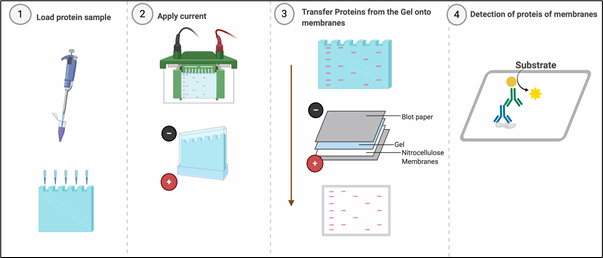
Western blotting or immunoblotting is an indispensable technique, almost every published paper in area of molecular cell biology uses western blotting for detecting specific proteins in a sample of tissue homogenate or cell lysates. Western blotting combines resolving power of polyacrylamide gel electrophoresis (PAGE) or SDS-PAGE and specificity of antibodies to detect target proteins. Proteins are resolved on the basis of their molecular weight in SDS-PAGE and transferred from the polyacrylamide gel onto the membranes (Nitrocellulose or PVDF), which creates an exact replica of the protein separation pattern on the membrane. After transferring the proteins to the membrane, the membrane needs ‘blocking’ to ‘block’ non-specific binding sites on the surface of the membrane. Blocking is usually performed with Bovine Serum Albumin, Skimmed milk or purified milk Casein.
Read More
Topics:
Protein Purification,
Western Blotting,
Protein Electrophoresis,
Protein Estimation,
Sample Clean Up,
Protease Inhibitors,
Protein Extraction,
Protein Detection