
Water is described as the “universal solvent,” and in scientific research and industrial processes, its quality can be the single most critical variable in success or failure. Contaminants present in water—ions, organics, particulates, and microbes—can interfere with chemical reactions, skew analytical readings, promote microbial growth, or corrode sensitive equipment. Consequently, a rigorous classification system for water purity has been established. Understanding the types and grades of water is essential for selecting the right water for the right application, ensuring reliability, reproducibility, and safety.
This guide details the major types of purified water, defined by international standards from organizations like ASTM (American Society for Testing and Materials), ISO (International Organization for Standardization), CLSI (Clinical and Laboratory Standards Institute), USP (United States Pharmacopeia), and their specific applications across different sectors.
The Spectrum of Water Purity:
Water purity is defined by the absence of specific contaminants. Laboratories and industries use progressively intensive purification methods to remove impurities, resulting in different "grades" of water. The key parameters monitored include:
- Resistivity/Conductivity: Measures ionic purity. High-purity water has high resistivity (up to 18.2 MΩ·cm at 25°C) and very low conductivity.
- Total Organic Carbon (TOC): Quantifies organic molecules present, measured in parts per billion (ppb).
- Microbiological Contaminants: Includes bacteria, endotoxins, and nucleases.
- Particulates: Solid matter suspended in the water.
No single grade is perfect for all applications. The choice of water grade is a balance between the required purity, throughput needs, and cost.
Common Types and Grades of Purified Water
|
Aspect |
Type III: Primary Grade Purified Water (ASTM) |
Type II: General Laboratory Grade Water (ASTM) |
Type I: Ultrapure Water (ASTM) |
|
Description |
This is the baseline grade of purified water. It is free of most ions and a significant portion of organics and microbes, but not suitable for sensitive work. |
A significant step up in purity, Type II water has very low levels of ions, organics, and bacteria. It is the workhorse for many general lab procedures. |
This is the gold standard for critical laboratory work. Represents the theoretical maximum purity for water, with virtually all ionic, organic, particulate, and microbial contaminants removed. |
|
Production |
Typically generated by reverse osmosis (RO) or deionization (DI). |
Produced by distilling Type III water or using a combination of RO, DI, and electro deionization (EDI) |
Final polishing of Type II water via technologies like recirculating ultrapure polishers with UV photo-oxidation, activated carbon, and ultrafiltration. |
|
Specifications |
Resistivity >1 MΩ·cm; TOC <500 ppb. |
Resistivity >1 MΩ·cm (often >5 MΩ·cm); TOC <100 ppb. |
Resistivity 18.2 MΩ·cm; TOC <10 ppb (often <5 ppb); bacteria <1 CFU/mL; filtered to 0.2 or 0.05µm. |
|
Applications |
• Rinsing laboratory glassware and non-critical apparatus • Filling autoclaves and water baths • Environmental chambers and plant growth facilities. • Non-critical industrial processes like cooling or humidification. |
• Preparation of buffers, media, and reagents for general chemistry and biology. • Sample and standard dilution in analytical techniques like HPLC. • Microbiological media preparation • Industrial quality control testing. |
• Molecular Biology: PCR, DNA/RNA sequencing, and cloning. • Cell Culture: Mammalian and tissue culture work. • ICP-MS, LC-MS, and GC-MS: Trace element and mass spectrometry analysis. • HPLC and UHPLC: Mobile phase preparation. • Critical reagent preparation for sensitive assays (e.g., ELISA). |
Specialized Grades for Specific Applications
1. Specialized Molecular & DNA/RNA-Specific Grades
|
Water Grade |
Key Specification |
Primary Application |
Production Method |
Critical Contaminant Removed |
Storage & Handling |
|
RNase-free, DEPC inactivated |
RNA isolation, RT-PCR, RNA sequencing |
Add 0.1% DEPC and incubate 12h. Autoclave to remove residual DEPC |
RNases, DNases (secondary) |
Store at 4°C, use within 6 months |
|
|
Nuclease-free (DNase/RNase) |
Molecular biology, cloning, DNA work |
UV treatment, filtration, DEPC-free chemistry |
RNases, DNases, proteases |
Room temp, sterile packaging |
|
|
Nuclease-Free Water |
Certified DNase/RNase free |
Sensitive DNA/RNA applications |
Ultrafiltration, autoclaving. |
All nucleases |
Single-use aliquots recommended |
|
PCR-Grade Water |
Amplification inhibitor-free |
PCR, qPCR, DNA amplification |
UV-irradiated, 0.1 µm filtered |
PCR inhibitors, nucleases |
Pre-aliquoted, DNase/RNase-free tube |
2. Analytical & Cell Culture Grades
|
Water Grade |
Key Specification |
Primary Application |
Typical Purity |
Critical Parameters |
Validation Requirement |
|
Mass Spec Grade |
Ultra-low TOC & metals |
LC-MS, GC-MS, proteomics |
Type I+ (18.2 MΩ·cm) |
TOC < 5 ppb |
Weekly TOC & metals testing |
|
<0.25 EU/mL endotoxin |
Cell culture, immunology |
Type I |
Endotoxin < 0.25 EU/mL |
LAL test validation |
|
|
Sterile, 0.9% Benzyl Alcohol, <0.25 EU/mL endotoxin |
Solvent for dissolving chemicals |
Type I |
Endotoxin < 0.25 EU/mL |
LAL test validation |
|
|
Cell Culture Grade |
Sterile, endotoxin-free |
Mammalian cell culture |
Type I |
Sterile, <0.25 EU/mL endotoxin |
Sterility & growth promotion tests |
|
HPLC Grade |
Low UV absorbance |
Chromatography mobile phase |
Type I |
UV abs. <0.001 @ 254 nm |
UV scan validation |
3. Pharmaceutical & Industrial Grades
|
Water Grade |
Standard/ Regulation |
Primary Application |
Production Method |
Release Tests |
Storage/ Distribution |
|
USP, EP, JP |
Injectable drugs, dialysis |
Distillation or validated RO |
Sterility, endotoxin, conductivity, TOC |
Hot (80°C+) circulating system |
|
|
Purified Water (Pharma) |
USP, EP |
Oral drugs, cleaning |
RO + EDI/ion exchange |
Conductivity, TOC, microbial limits |
Ambient, may include UV |
|
Biotech Process Water |
cGMP |
Fermentation, downstream |
Multi-step purification |
Conductivity, bioburden, endotoxin |
System-specific validation |
|
Clean Steam Condensate |
cGMP |
Sterilization, humidification |
Pure steam generation |
Conductivity, endotoxin, TOC |
Point-of-use collection |
Strategic Selection and System Maintenance:
Select water grade based on application sensitivity—not just purity level.
Always validate against your specific workflow requirements and monitor key parameters regularly for consistency.
• Choosing the Correct Water Grade:
Reserve Type I (ultrapure) water for highly sensitive procedures like mass spectrometry or molecular biology where contaminants would invalidate results. Type II water suffices for reagent preparation and general lab work, while Type III works well for rinsing glassware and non-critical applications.
• Optimizing Purification Systems:
A multi-stage purification setup—where Type III feeds into Type II, which then polishes to Type I—balances cost with reliability. This tiered approach minimizes waste while delivering appropriate purity at each usage point.
• Preserving Water Quality:
Pure water degrades through microbial colonization and gas absorption (particularly CO₂). Implement point-of-use filtration, recirculation loops, and regular monitoring of resistivity, TOC, and microbial counts to maintain integrity. Systems should be sized to match daily usage to avoid stagnation.
• Instrument Compatibility:
Verify that your water system aligns with instrument requirements—some analytical platforms need in-line degassing or additional organic removal to prevent baseline drift or signal interference.
• Why the Right Water Grade Matters: A Final Consideration
Water is a foundational laboratory reagent. Its purity directly influences experimental reproducibility, analytical accuracy, and process reliability. While standards like ASTM and ISO provide useful guidelines, your specific application dictates the necessary specifications.
At G-Biosciences, we understand that water quality underpins success across life science workflows. Our application-specific solutions—from nuclease-free formulations for DNA/RNA research to endotoxin-controlled water for cell culture—support precision and confidence in your work. Water purity is a variable you can and should control with intention.
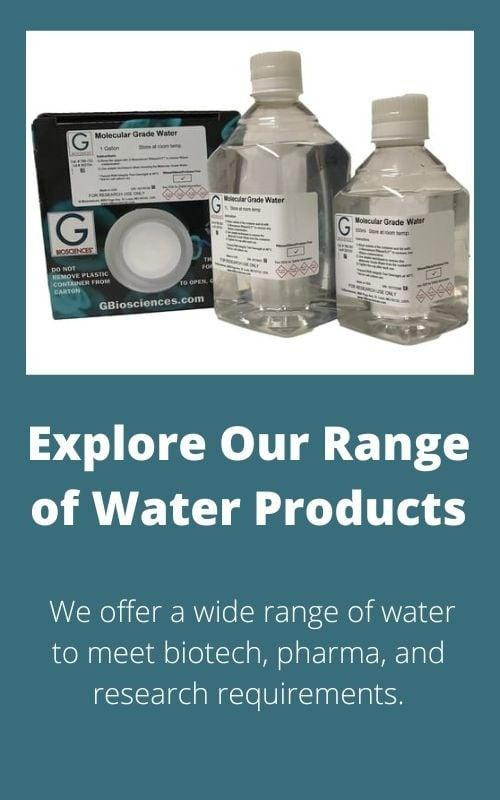
Figure 1. Molecular Grade Water
References
- Phan, A. et al. (2024). Ecological distribution of Staphylococcus in integrated farms within Washington DC –Maryland. Journal of Food Safety. 44. 10.1111/jfs.13123
- Bangruwa, Neeraj et al (2022) CISS-based label-free novel electrochemical impedimetric detection of UVC-induced DNA damage. ACS OMEGA. https://doi.org/10.1021/acsomega.2c04659
- Park, J. et al. (2025). Multilayer Adjuvanted Influenza Protein Nanoparticles Improve Intranasal Delivery and Antigen-Specific Immunity. ACS nano, 19(7), 7005–7025. https://doi.org/10.1021/acsnano.4c14735
- Cappoli, N. et al (2021) Effects of remifentanil on human C20 microglial pro-inflammatory activation. EUR REV MED PHARMACOL. 2021; 25: 5268-5274
- Natalia, A. S. et al (2021) Determination of Antibacterial Activity of Film Coatings against Four Clinically Relevant Bacterial Strains. Colloids Surf B Biointerfaces. DOI:10.21769/BioProtoc.3887
- Stark, Maren et al (2022) Dissecting the role of toll-like receptor 7 in pancreatic cancer. CANCER MED-UK. https://doi.org/10.1002/cam4.5606
- Borsodi, A. K. et al (2020) Comparison of planktonic and reed biofilm bacteria in different riverine water bodies of river Danube. River Res Appl.DOI: 10.1002/rra.3597
- Brakat, R. et al. (2023). THERAPEUTIC EFFICACY OF RESIQUIMOD ON TREATING CHRONIC TOXOPLASMOSIS IN EXPERIMENTAL INFECTED MICE. Journal of the Egyptian Society of Parasitology. 53. 537-546. 10.21608/jesp.2023.331739.
- Hossen, M. N. et al (2019) Gold nanoparticle transforms activated cancer-associated fibroblasts to quiescence. ACS Appl. Mater. Interfaces. doi.org/10.1021/acsami.9b03313.