
Why SAM Methyltransferases Matter
S-adenosylmethionine (SAM), also known as AdoMet, is the cell's primary methyl donor, second only to ATP in overall cofactor usage. SAM methyltransferases transfer that methyl group onto target substrates, and the resulting modifications shape core cellular processes. Signal transduction pathways depend on methylation events to relay information. Chromatin regulation relies on methyltransferases to control gene accessibility. Protein repair mechanisms use methylation to correct damaged residues, and gene-silencing pathways use the same chemistry to switch expression off.
Aberrant SAM levels have been studied in connection with a range of conditions, including liver disease, cancer, depression, and Parkinson's disease, with more limited evidence linking altered SAM metabolism to Alzheimer's. That range of associated conditions explains why pharmaceutical and academic labs alike treat methyltransferase activity as a serious research target rather than a niche biochemical curiosity.
The Measurement Problem
Every SAM-dependent methylation reaction generates the same byproduct: S-adenosylhomocysteine (SAH). Researchers can exploit this byproduct to track enzyme activity, but older detection methods forced a tradeoff between sensitivity and practicality. Radiolabeled SAM substrates deliver strong signal but introduce regulatory burden and safety overhead. Endpoint colorimetric methods avoid radioactivity but sacrifice the ability to watch a reaction progress, which limits their usefulness for kinetic characterization or inhibitor screening. A truly useful assay needs to eliminate both drawbacks at once.
How Enzyme-Coupled Detection Solves the Measurement Problem
An enzyme-coupled detection system turns SAH production into a continuous, measurable signal rather than a single data point. As soon as a methyltransferase strips the methyl group from SAM, the reaction produces S-adenosylhomocysteine (SAH). Left alone, SAH would build up and start suppressing the very methylation reaction being studied, but a coupled nucleosidase enzyme clears it almost as fast as it forms, breaking it down into adenine and S-ribosylhomocysteine. A second enzyme, adenine deaminase, converts that adenine into hypoxanthine, which is then converted into urate along with hydrogen peroxide. Because hydrogen peroxide accumulates in step with methyltransferase activity, tracking it gives researchers a live, continuous readout of the reaction instead of a single endpoint value.
This chemistry underlies two related SAM Methyltransferase Assay formats from G-Biosciences. The SAM510TM assay reads absorbance at 510 nm, suited to standard plate readers, and the SAM-fluoro assay swaps in a fluorescent readout for work with dilute enzyme concentrations or limited sample volume. Both assays run continuously and avoid both radioactive labeling and endpoint measurement. Because the underlying chemistry depends only on the nucleosidase recognizing its substrate, the platform isn't limited to classical methyltransferases: any purified enzyme that generates SAH or 5'-methylthioadenosine as a byproduct can be monitored the same way, extending its reach to other SAM-dependent enzyme classes, including those involved in polyamine biosynthesis.
Applications Across Research Pipelines
Continuous kinetic data expands the range of questions a lab can answer with a single assay format. Instead of yes/no or before and after comparisons, researchers can ask how fast a reaction runs, how that rate shifts under different conditions, and what that shift reveals about mechanism. Enzymologists can determine Km and Vmax values without stitching together multiple endpoint reactions. Drug discovery teams can screen inhibitor libraries and watch dose-dependent kinetic shifts in real time rather than inferring them from single time points. Epigenetics researchers studying histone or DNA methyltransferases gain a way to characterize enzyme activity that sits upstream of chromatin state, connecting biochemical measurement directly to downstream biology.
G-Biosciences' SAM510TM and SAM-fluoro assays provide continuous, quantitative insight into SAM methyltransferase activity without radioactive labels or cumbersome endpoint workflows.
Figure 1: SAM Methyltransferase Assay
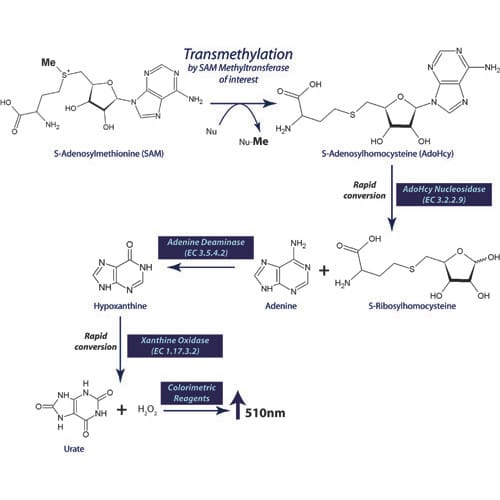
Figure 2: Bioassay Handbook

References
- Gong, C. et al (2023) Nucleic Acids Research. Volume 52, Issue 2, Pages 856–871. https://doi.org/10.1093/nar/gkad1150
- Ali, Sabeeha et al (2021) Immune Responses. FRONT CELL INFECT MI. https://doi.org/10.3389/fcimb.2021.622487
- Colin, P.Y. et al (2020) Sci Rep. DOI:10.1038/s41598-
- Dou, L. et al (2019) NAT COMMUN. https://doi.org/10.1038/s41467-019-12960-6
- Singh, J. et al (2019) Pivotal drug target. PLOS ONE 14:8e0221032.
- Carney, A. and Holden, H.M. (2011) Biochemistry. 50:780